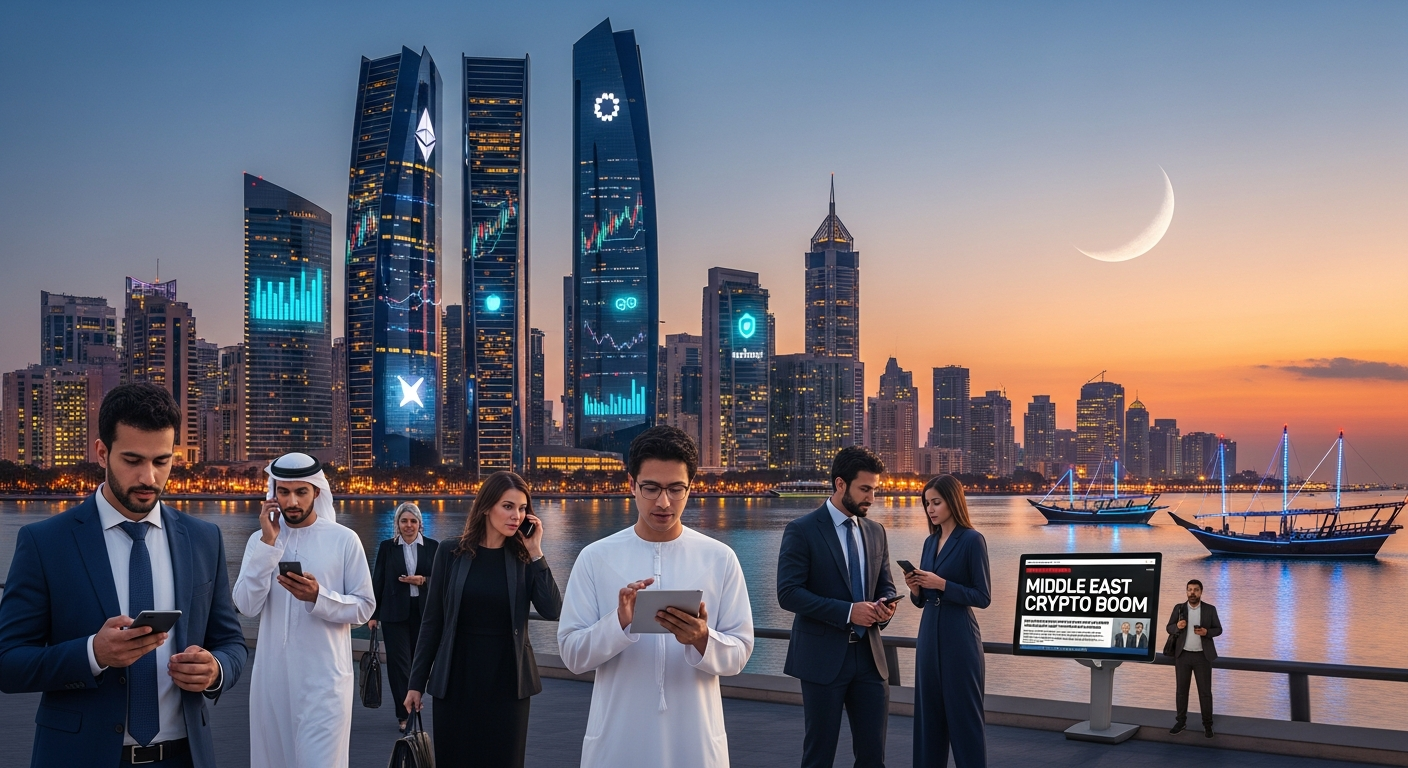
The global crypto industry is increasingly turning its attention to the Middle East, with Abu Dhabi and the wider Gulf region emerging as a strategic hub for digital asset firms seeking regulatory clarity, capital access, and long-term stability.
Over the past year, major exchanges, blockchain developers, and institutional investors have expanded operations across the United Arab Emirates, signaling a structural shift in the geography of global crypto influence.
Why Abu Dhabi Is Attracting Crypto Giants
At the center of this movement is Abu Dhabi Global Market (ADGM), one of the world’s most advanced regulatory frameworks for digital assets. Unlike jurisdictions that oscillate between enforcement and uncertainty, Abu Dhabi has offered crypto firms something rare: clear rules and predictable oversight.
Under ADGM’s regime, crypto companies can obtain licenses covering exchanges, custody, brokerage, and asset management—providing a compliant pathway for institutional participation.
“Regulatory certainty is the new competitive advantage,” said a regional fintech advisor. “Abu Dhabi understands that innovation needs rules, not ambiguity.”
Sovereign Capital Changes the Game
Beyond regulation, the Middle East offers something few regions can match: deep pools of sovereign capital. Wealth funds across the Gulf manage trillions of dollars and are increasingly open to blockchain, tokenization, and digital infrastructure investments.
Crypto executives attending recent industry events in the region have emphasized that conversations are shifting away from speculation toward long-term infrastructure—custody, settlement, tokenized real-world assets, and regulated trading platforms.
For crypto firms navigating tighter funding conditions in the U.S. and Europe, the Middle East represents a rare growth opportunity.
A Strategic Alternative to Western Markets
The rise of the Middle East as a crypto hub also reflects broader geopolitical and economic shifts. As regulatory pressure intensifies in the U.S. and compliance costs rise in Europe, firms are diversifying operational footprints to reduce jurisdictional risk.
Abu Dhabi and Dubai, in particular, offer:
Business-friendly tax environments
Access to global talent
Modern financial infrastructure
Strategic positioning between Asia, Europe, and Africa
This makes the region an attractive base for global crypto operations without abandoning Western markets entirely.
Institutional Focus Over Retail Speculation
Unlike previous crypto booms driven by retail speculation, the Middle East’s crypto strategy is notably institutional-first. Regulators and investors are prioritizing custody, compliance, tokenization of real-world assets, and cross-border payments rather than high-risk consumer trading.
This approach aligns closely with the industry’s post-crisis evolution following major collapses earlier in the decade.
“Crypto is maturing,” said an investment executive based in the Gulf. “What we’re building here is infrastructure, not hype.”
Risks and Challenges Remain
Despite the momentum, challenges persist. Global regulatory coordination remains uneven, and crypto firms must still comply with international standards on anti-money laundering, sanctions, and data protection.
There is also the risk that rapid expansion could outpace regulatory capacity if not carefully managed.
However, regional authorities have emphasized that growth will remain controlled and compliance-driven.
A New Center of Gravity for Crypto
The growing concentration of crypto activity in the Middle East suggests a long-term shift rather than a temporary trend. With capital, clarity, and ambition aligned, the region is positioning itself as a neutral global meeting point for digital finance.
As the crypto industry evolves from its experimental phase into a regulated financial sector, Abu Dhabi’s rise reflects a simple reality: in the race for digital asset leadership, certainty and capital matter more than slogans.
For crypto firms seeking stability in an increasingly fragmented global landscape, the Middle East is no longer optional—it is becoming essential.